Saturday, October 15, 2011

Pipedown!

imageI was sitting at work on Friday, struggling to find the gist of a paper I was reading, when I realised that a big factor in my failure to comprehend it was down to Pat Benatar.  Someone had a radio on, and the 80’s pop process was belting out Love is a Battlefield*.

I could have shut my office door to preserve the silence, but that runs contrary to the oft-quoted need for an open-door policy with staff, so I didn’t.  I should have been able to shut it out, just like you do when working in a noisy office environment, but I couldn’t.  Why not?  I think it’s because there’s a sense of grim anticipation – the sure knowledge that another excruciating lyric is on its way, and once it’s gone, you know that the same line will be back time and time again, or another one equally worthless.

I eventually found the miscreant and got them to turn the radio off, but it got me wondering why people think it’s OK to foist their musical preferences on others.  Consequently it was something of a coincidence when I discovered, via some tweet or other, the Pipedown website.  This group, which numbers such luminaries as Stephen Fry, is committed to the abolition of piped music in public places such as department stores and restaurants.  I’d advocate adding offices to their list as well.

* note to Pat – it’s nothing like a battlefield.  Totally different things.

Monday, October 10, 2011

The Lost Art of Music Composition

imageI’m a big fan of our symphony orchestras including works by contemporary composers in their programs, in particular works by contemporary Australian composers.  We’ve heard plenty of good modern material as a result, such as Sculthorpe’s Sun Music III a few weeks ago, Edwards’ Veni, Creator Spiritus and Vine’s Microsymphony, to name a few.

However, one thing all these pieces have in common has been their brevity. Ten or twelve minutes generally sees them out, which seems to work for most people.

Brett Dean, whose four movement violin concerto “The Lost Art of Letter Writing” was played by the ASO at its French Beauty concert on 7 and 8 October, took us on a somewhat different tack.  A mere 38 minutes worth, and I have to admit I was struggling a bit after about 3 minutes.  The thing raised a few issues in my mind:

  1. Dean wrote the piece in 2006, but (aside from the ACO*) none of the major symphony orchestras played it until this year, when three (count ‘em, three! - ASO, MSO, SSO) have scheduled it.  I assume this was because the piece won a  major prize for composition in 2009, at which point everyone decided they ought to schedule it.
  2. The soloist (Sophie Rowell) did an excellent job with the piece.  In some ways the nature of the music made it easy to really appreciate her efforts, in other ways it made it difficult to keep concentrating on what she was doing.
  3. I would have thought that with any solo violinist the program really ought to have a few lines on the violin he or she is playing.  In this case I assume Rowell was playing the Guadagnini which was purchased (with considerable foresight) in 1955 for 1750 pounds by the SA Guadagnini Trust.
  4. I wonder what the reason was for the long pregnant pause between the orchestra tuning up and Rowell and Volmer walking on stage to start the Dean piece.  I have a mental picture of Rowell being dragged kicking and screaming onto the stage…and who could blame her!

*Update

“Anonymous” has questioned the premise that the ACO has played this piece at all, falling in to the trap of supposing that the ACO refers to the Australian Chamber Orchestra, as opposed to the Ardrossan Community Orchestra, which premiered this piece years ago.  Actually that’s a lie (although it remains a possibility!) and I’m not quite sure why I thought the ACO has played this – probably because it’s just the sort of piece they ought to play, or the sort of piece they would play.  See the comments for further observations about the timing of the multiple instances of this piece now appearing in various programs.

Sunday, September 25, 2011

Volmer’s Law

I’ve come to the conclusion that there’s some form of physical law governing the likelihood of a mobile phone firing off in the middle of a concert, and it’s essentially that the likelihood of this happening is inversely proportional to the volume of the music being played, thus:

image

I struck this a while ago during one of the relatively few quiet moments in Rachmaninov’s Rhapsody on a Theme of Paganini, and again last Saturday.  The program consisted of Sculthorpe’s Sun Music III (during while the fire alarms could have sounded, and we’d simply have assumed that they were scripted), followed by Sibelius’ King Christian II Suite, a robust piece with few quiet spots, one of which was neatly filled with the trilling of a mobile phone.  The fact that the concert was being broadcast live on the ABC only added to the sense of inevitability.  As Arvo Volmer was on the podium on both occasions it seems fair the append his name to this momentous scientific breakthrough.

Mercifully the phones remained silent (as did the coughers and sneezers) during the star turn of the night, Beethoven’s Emperor concerto with Nikolai Demidenko as soloist.  It was a great performance, the ensuing applause bringing forth not one but two encores.  He didn’t announce what the encores were (at a guess I’d say they were both Chopin, with a nocturne followed by a mazurka) – the obvious solution was to hold up a Shazam enabled mobile phone, but given the earlier excitement this didn’t seem like such a great idea.

Tuesday, September 20, 2011

Snail Mail and the MSO

image

Go figure.  I jump online to get a copy of the MSO’s 2012 program.  It’s ready to go, but I get this message:

Request a 2012 Brochure

If you would like to find out more about our 2012 Season and you would like to receive a 2012 Season Brochure, please complete the brochure request form and one will be mailed to you.

To paraphrase Dilbert, this must come in very handy if someone from the 1980s is trying to get concert tickets.

Saturday, September 17, 2011

Westralian Symphony Orchestra

imageIt looks like the folks out west are about ready for secession (again!).  Of the 64 pieces listed in their 2012 program, all of one piece was written by an Australian.  Count ‘em, one! Ross Edwards (whose piece it is: Full Moon Dances) must feel honoured indeed!

One wonders what the Australia Council thinks of this – you’d reckon they’d expect a bit more bang for their buck in terms of local content.

Friday, September 2, 2011

ACO 2012 Season – a triumph for flannelette

Here’s a few observations about the ACO’s 2012 season brochure, which I received today:

image

          • The svelte Russell Crowe look on the cover is definitely eye-catching.    Could this be the very first time a man in a flannelette shirt has appeared on the front cover of a major orchestral ensemble’s new season program?  If so, why has it taken so long?
          • Ideally there’d be a Winnie Blue dangling from the corner of Tognetti’s mouth but we can’t have everything.
          • Has someone found God?  The program includes a lot of religious toe-tappers:
            • Ah, Gentle Jesu
            • Most Holy Mother of God
            • Veni Creator Spiritus (three times!)
            • Exsultate Jubilate
            • Prayer of Christ Ascending Towards His Father

image


          • The ACO appears to have significantly decreased its component of music written by living composers, but two of the composers only died quite recently: Meale (2009) and Gorecki (2010)
          • If these two were treated as living composers (although the technology is currently beyond us) the Live Music ratio jumps to 20%


image


          • After flirting last year with a few more pieces appearing on the composite “top 200 classical classics” lists, the ACO has again reverted to avoiding these works like the plague, mostly


image


          • The Repertoire Safety Index has dropped a bit, indicating that the ACO is playing more works by famous composers, but not necessarily their famous works
          • It remains to be seen whether one of the other orchestras will trump them on this score


image


          • For the record, works by Australian composers steady at 9%

Tuesday, August 30, 2011

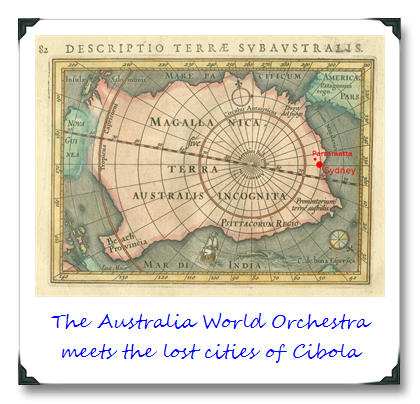
Terra Australis World Orchestra

You can sense the excitement over at the brand new “Australia World Orchestra” website:

One of the most exciting orchestral initiatives in Australia, the Australian World Orchestra’s (AWO) vision is simple: to bring together Australia’s finest classical musicians from around the world to form one of the country’s most electrifying orchestras.

I can hardly wait to see them, and there’s four concerts to choose from:

  • Sydney
  • Sydney
  • Sydney
  • Parramatta

Parramatta?  Why bother leaving the CBD at all?

Still, I guess it’s a big country, and a full orchestra can’t zip around like the ACO, so I’ll just have to content myself with the webcast.  The what-cast?  Chance would be a fine thing!

Tuesday, August 23, 2011

Cellists in mini skirts

Yuja Wang’s appearance at the Hollywood Bowl, to play Rachmaninov’s Piano Concerto No. 3 while simultaneously wearing this body hugging outfit and appropriate clubbing heels, has attracted more than its fair share of comment, a couple of which are worth repeating here.

First up, music critic Robert D. Thomas, writing in the Pasadena Star-News, explained that:

It also may (or may not) be worth mentioning that she came on stage last night wearing the shortest dress I’ve ever seen a female pianist wear, an orange sheath that elicited gasps from the audience.

I can only infer from this that Robert D. Thomas has in fact seen shorter skirts, but only on male pianists.  Is he prepared to name names?  What sort of town is Pasadena anyway?  Cue Monty Python…

Pasadena squire? Famous place! Nudge nudge, wink wink, say no more.

As for the other quotable quote, this came from her indoors, who when confronted with the Yuja Wang photo, simply asked “Is she a cellist?”

I wonder what Robert D. would have made of that!


Postscript to this piece – someone has injected some nice solid science into the debate – see Visual Cues Impact Judgment of Piano Performances.

Monday, August 15, 2011

The SSO and Local Talent

imageThe Sydney Symphony Orchestra is the first out of the blocks with their 2012 program.  While it’s encouraging to see that they have upped their Repertoire Safety Index, it’s still well below average at 5.3.  What’s more concerning is that their Australian composed content has fallen to a dismal 5%.

It’s nice see that our premier orchestra – funded as they are by the Feds to the tune of a lazy $10 million or so – have been able to ensure that works composed by Australians edge out those composed by Hungarians (3%), Brazilians and Argentinians (both 2%), but it pales a bit in comparison with the volume of works composed by Russians (16%), French (19%) and Germans (24%).

Here are the results…could try harder!

image

Sunday, July 31, 2011

AMPAG

The Australian Major Performing Arts Group has released its 10th survey of arts group funding and the finding are much as you’d expect:

image

No surprise, given the staff numbers involved, that the music related major performing groups underperform the overall average:

image

One thing which did strike me as unusual was the results for major arts groups based in Victoria:

image

As I discussed here, the Melbourne Symphony Orchestra had a significant jump in its grant related income to total income ratio, going from 52% in 2009 to 57% in 2010.  Given the size of the MSO grants ($13.7m in 2010) it’s hard to see how the average could be so low.  There must be a bunch of Victorian arts organisations operating on the proverbial shoe-string.