Sunday, September 25, 2011

Volmer’s Law

I’ve come to the conclusion that there’s some form of physical law governing the likelihood of a mobile phone firing off in the middle of a concert, and it’s essentially that the likelihood of this happening is inversely proportional to the volume of the music being played, thus:

image

I struck this a while ago during one of the relatively few quiet moments in Rachmaninov’s Rhapsody on a Theme of Paganini, and again last Saturday.  The program consisted of Sculthorpe’s Sun Music III (during while the fire alarms could have sounded, and we’d simply have assumed that they were scripted), followed by Sibelius’ King Christian II Suite, a robust piece with few quiet spots, one of which was neatly filled with the trilling of a mobile phone.  The fact that the concert was being broadcast live on the ABC only added to the sense of inevitability.  As Arvo Volmer was on the podium on both occasions it seems fair the append his name to this momentous scientific breakthrough.

Mercifully the phones remained silent (as did the coughers and sneezers) during the star turn of the night, Beethoven’s Emperor concerto with Nikolai Demidenko as soloist.  It was a great performance, the ensuing applause bringing forth not one but two encores.  He didn’t announce what the encores were (at a guess I’d say they were both Chopin, with a nocturne followed by a mazurka) – the obvious solution was to hold up a Shazam enabled mobile phone, but given the earlier excitement this didn’t seem like such a great idea.

Tuesday, September 20, 2011

Snail Mail and the MSO

image

Go figure.  I jump online to get a copy of the MSO’s 2012 program.  It’s ready to go, but I get this message:

Request a 2012 Brochure

If you would like to find out more about our 2012 Season and you would like to receive a 2012 Season Brochure, please complete the brochure request form and one will be mailed to you.

To paraphrase Dilbert, this must come in very handy if someone from the 1980s is trying to get concert tickets.

Saturday, September 17, 2011

Westralian Symphony Orchestra

imageIt looks like the folks out west are about ready for secession (again!).  Of the 64 pieces listed in their 2012 program, all of one piece was written by an Australian.  Count ‘em, one! Ross Edwards (whose piece it is: Full Moon Dances) must feel honoured indeed!

One wonders what the Australia Council thinks of this – you’d reckon they’d expect a bit more bang for their buck in terms of local content.

Friday, September 2, 2011

ACO 2012 Season – a triumph for flannelette

Here’s a few observations about the ACO’s 2012 season brochure, which I received today:

image

          • The svelte Russell Crowe look on the cover is definitely eye-catching.    Could this be the very first time a man in a flannelette shirt has appeared on the front cover of a major orchestral ensemble’s new season program?  If so, why has it taken so long?
          • Ideally there’d be a Winnie Blue dangling from the corner of Tognetti’s mouth but we can’t have everything.
          • Has someone found God?  The program includes a lot of religious toe-tappers:
            • Ah, Gentle Jesu
            • Most Holy Mother of God
            • Veni Creator Spiritus (three times!)
            • Exsultate Jubilate
            • Prayer of Christ Ascending Towards His Father

image


          • The ACO appears to have significantly decreased its component of music written by living composers, but two of the composers only died quite recently: Meale (2009) and Gorecki (2010)
          • If these two were treated as living composers (although the technology is currently beyond us) the Live Music ratio jumps to 20%


image


          • After flirting last year with a few more pieces appearing on the composite “top 200 classical classics” lists, the ACO has again reverted to avoiding these works like the plague, mostly


image


          • The Repertoire Safety Index has dropped a bit, indicating that the ACO is playing more works by famous composers, but not necessarily their famous works
          • It remains to be seen whether one of the other orchestras will trump them on this score


image


          • For the record, works by Australian composers steady at 9%

Tuesday, August 30, 2011

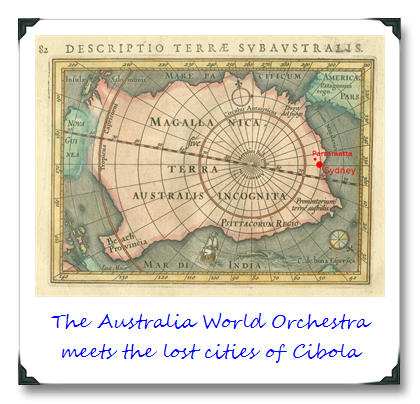
Terra Australis World Orchestra

You can sense the excitement over at the brand new “Australia World Orchestra” website:

One of the most exciting orchestral initiatives in Australia, the Australian World Orchestra’s (AWO) vision is simple: to bring together Australia’s finest classical musicians from around the world to form one of the country’s most electrifying orchestras.

I can hardly wait to see them, and there’s four concerts to choose from:

  • Sydney
  • Sydney
  • Sydney
  • Parramatta

Parramatta?  Why bother leaving the CBD at all?

Still, I guess it’s a big country, and a full orchestra can’t zip around like the ACO, so I’ll just have to content myself with the webcast.  The what-cast?  Chance would be a fine thing!

Tuesday, August 23, 2011

Cellists in mini skirts

Yuja Wang’s appearance at the Hollywood Bowl, to play Rachmaninov’s Piano Concerto No. 3 while simultaneously wearing this body hugging outfit and appropriate clubbing heels, has attracted more than its fair share of comment, a couple of which are worth repeating here.

First up, music critic Robert D. Thomas, writing in the Pasadena Star-News, explained that:

It also may (or may not) be worth mentioning that she came on stage last night wearing the shortest dress I’ve ever seen a female pianist wear, an orange sheath that elicited gasps from the audience.

I can only infer from this that Robert D. Thomas has in fact seen shorter skirts, but only on male pianists.  Is he prepared to name names?  What sort of town is Pasadena anyway?  Cue Monty Python…

Pasadena squire? Famous place! Nudge nudge, wink wink, say no more.

As for the other quotable quote, this came from her indoors, who when confronted with the Yuja Wang photo, simply asked “Is she a cellist?”

I wonder what Robert D. would have made of that!


Postscript to this piece – someone has injected some nice solid science into the debate – see Visual Cues Impact Judgment of Piano Performances.

Monday, August 15, 2011

The SSO and Local Talent

imageThe Sydney Symphony Orchestra is the first out of the blocks with their 2012 program.  While it’s encouraging to see that they have upped their Repertoire Safety Index, it’s still well below average at 5.3.  What’s more concerning is that their Australian composed content has fallen to a dismal 5%.

It’s nice see that our premier orchestra – funded as they are by the Feds to the tune of a lazy $10 million or so – have been able to ensure that works composed by Australians edge out those composed by Hungarians (3%), Brazilians and Argentinians (both 2%), but it pales a bit in comparison with the volume of works composed by Russians (16%), French (19%) and Germans (24%).

Here are the results…could try harder!

image

Sunday, July 31, 2011

AMPAG

The Australian Major Performing Arts Group has released its 10th survey of arts group funding and the finding are much as you’d expect:

image

No surprise, given the staff numbers involved, that the music related major performing groups underperform the overall average:

image

One thing which did strike me as unusual was the results for major arts groups based in Victoria:

image

As I discussed here, the Melbourne Symphony Orchestra had a significant jump in its grant related income to total income ratio, going from 52% in 2009 to 57% in 2010.  Given the size of the MSO grants ($13.7m in 2010) it’s hard to see how the average could be so low.  There must be a bunch of Victorian arts organisations operating on the proverbial shoe-string.

Wednesday, June 29, 2011

Moneyball–the musical

Greg Sandow started an interesting conversational thread when he raised – in an interview with The Australian (here), the prospect that orchestras composed of young musicians might make up for a lack of polish with extra pizzazz.  He’s expounded on this in various blogs (here, here and here) and elaborated on what he feels is a forgotten discipline, that of assessing the quality of an orchestra. 

He highlights four key issues:

        • technical excellence (balance, intonation, ensemble)
        • the strength of each section, and of each principal
        • how well the orchestra plays various musical styles
        • whether the orchestra plays with edge of the seat excitement, with melting passion, with visible and audible commitment

I thought it was interesting that Sandow has omitted to raise the issue of audience engagement. This in turn raises another interesting question…what is the point of an orchestra?  They have a number of important functions, from preserving our musical and cultural traditions, to educating us, to providing a vehicle for modern composers to show their stuff.  But when it’s all said and done, they are also here to entertain us , and there’s an objective that’s extremely easy to measure: ticket sales.

One of the problems of getting overly focussed on ticket sales and broad audience appeal is that its only a matter of time before you reach the point of skating rinks and light-classics-on-ice, the kind made famous by Voldemort.  However, surely audience numbers and audience engagement need to be factored into an audience assessment process.

Sandow uses plenty of baseball analogies in his pieces, and here’s another one.  Moneyball, a book by financial journalist and former Salomon Brothers trader Michael Lewis, is the story of a low-budget team (Oakland) building a winning record by buying cheap players who actually contribute to winning games (e.g. via a high on-base percentage) rather than expensive players who only appeared to be contributing to winning games (e.g. by home run production or stolen bases or golden glove defensive skills).  This was made possible by a very precise mathematical understanding of the things in baseball which are well correlated with winning, compared with things which appear to be important but aren’t in fact all that well correlated with winning.  So on this point perhaps Sandow is right – maybe we don’t really understand what makes a successful orchestra, and simply assume that artistic excellence, coupled with a few established international soloist, will do the trick.

Sunday, June 19, 2011

A Living Australian

The ASO ticked a couple of boxes this weekend by adding Carl Vine’s Microsymphony to a program including the Brahms Violin Concerto and Shostakovich Symphony No. 1. 

As I’ve noted here previously (also here), orchestras around the country don’t do enough to promote the work of a) living composers, and b) Australian composers, and Vine obviously satisfies both tests.  That said, the ASO doesn’t fare too badly on either score, with their 2011 program featuring 24% of pieces written by living composers, and 20% by Australian composers (contrast the Sydney SO – 8% and 6% respectively).

Microsymphony went over very well with the audience, as did the Shostakovich, but the star turn of the night was of course the Brahms Violin Concerto with Tasmin Little at the controls of her Stradivarius.  This was a tremendous performance, as you’d probably expect, but what I didn’t expect was that she’d take half an hour out prior to the start of the concert to give the pre-match address, along with violinist Lachlan Bramble.  I go along to these talks every chance I get, and have heard a range of

ASO musos, academics and teachers expounding on the music we’re about to hear, but I don’t think I can recall a single occasion when the soloist has taken part.  I’m sure they have a lot on their minds prior to a performance, and there’s an obvious language barrier in some cases, but surely more could follow this example and do a bit more to engage with their audiences.

In her talk Tasmin mentioned her Naked Violin project, which provides free downloads of a number of violin works (including Bach and Ysaye) along with some commentary.  It’s well worth a look.  This is her contribution to spreading classical music to the masses, using digital channels and not charging a cent for it.  As she said in her talk, she’s keen to prove that classical music doesn’t have to have such a narrow focus on people who are white, middle class and middle aged or older.  A bit ironic as her audience was entirely composed of that demographic, but you can understand what she’s driving at.